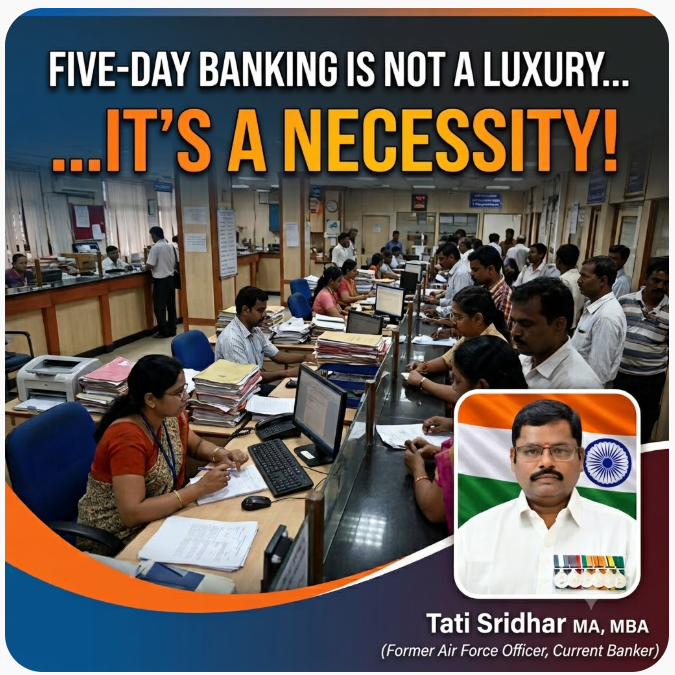
The banking sector is the backbone of any country’s economic development. From the formative years before 1969, through the era of nationalisation from 1969 to 1991, and into the modern era following liberalisation in 1991, the banking sector has consistently faced numerous challenges while remaining at the forefront of public service.
However, in today’s digital age, with rapid technological advancements, bankers’ workloads and mental stress have reached unprecedented levels. In this context, the demand for five-day banking is not merely a demand for an additional holiday; it is an essential requirement for employee well-being and a fundamental right to a healthy work-life balance.
1. Eight Hours on Paper, More Than Twelve Hours in Practice!
For the general public, bank working hours appear to extend only from morning to evening. However, the reality on the ground is very different. While official working hours may be eight hours, bankers often end up working more than twelve hours a day.
- Increasing work pressure: Competition in digital banking, persistent cybersecurity threats, constantly changing regulations, and severe staff shortages are placing an unbearable burden on bankers.
- Deteriorating health and work-life balance: Twelve hours of work a day, coupled with commuting time, leaves employees suffering from severe mental and physical exhaustion, leading to employee fatigue.
- Reluctance to accept promotions: The severity of the workload is evident from the fact that many employees are now hesitant even to accept promotions because of the additional responsibilities and pressure involved.
Just as banks undergo stress tests to assess their financial strength, the situation has reached a point where there is a need to assess how much stress an individual banker can reasonably withstand.
2. Five-Day Banking: A Reasonable and Justified Demand
The demand for five-day banking is not about seeking additional holidays. It is fundamentally about employee well-being and work-life balance.
- Improved productivity: Employees can perform better and maintain greater concentration when they receive adequate rest. Several international and domestic organisations have already successfully adopted a five-day working week.
- Uninterrupted service even during crises: It is an undeniable fact that bankers continued to serve the nation even during emergencies such as the COVID-19 lockdown, risking their lives and enduring immense mental stress to ensure the continuity of essential banking services.
The dedication demonstrated by bankers during such difficult times deserves recognition. Ensuring their well-being is equally important to sustaining the quality and continuity of banking services.
3. A Change in Leadership: The Need for Representation from the Current Generation
The banking industry has undergone a dramatic transformation. The technology, working methods, and business objectives of the past are very different from those of today. Modern bankers face intense pressure to achieve targets relating to deposits, loans, insurance, mutual funds, and other financial products.
“Retirement from service should also mean retirement from leadership.”
- Respect for retired employees: Retired employees who have dedicated decades of service to the banking sector deserve respect, recognition, and opportunities to provide guidance. However, there is a fundamental difference between guidance and leadership.
- Leadership that understands present-day realities: Employees working in branches are best placed to understand the ground realities, including vacancies, staff shortages, unrealistic targets, unilateral transfers, deputations, and the impact of these decisions on their children’s education and family life.
- The need for fresh leadership in unions: At a time when existing banking unions appear to be struggling to secure satisfactory outcomes through negotiations, there is a pressing need to entrust union leadership to the current generation of bankers, including Gen Z. If young Agniveers can shoulder the responsibility of protecting the nation’s borders, young bankers too can effectively lead their unions and fight for their legitimate rights.
- A generational change in union leadership is essential: When existing banking unions struggle to negotiate effectively, the need to make way for new leadership becomes increasingly important. If the ideology and approach of current union leaders are no longer acceptable to the present Central Government, it is all the more necessary for them to make way for a new generation of leaders.
If the upcoming wage revision negotiations are conducted by the same old union leadership, there is a genuine concern that employees may not even receive the wage revision they rightfully deserve. Fresh leadership, new ideas, and a more effective negotiation strategy are therefore essential to protecting the interests of bank employees.
If Gen Z is leading movements today, and Agniveers are safeguarding the nation, why can’t the present generation of bankers organise a movement and fight for their own rights?
Conclusion
Providing continuous and quality services to customers is undoubtedly important. However, safeguarding the health and well-being of the bankers who deliver those services is equally important.
In an environment characterised by excessive workloads, staff shortages, and mounting professional stress, the immediate implementation of five-day banking would significantly benefit the banking sector, the quality of public service, and the future of millions of bank employees.
A healthy banker is better equipped to serve customers, contribute to institutional growth, and uphold the trust that society places in the banking system. Five-day banking should therefore be viewed not as a concession, but as a progressive and necessary step towards a sustainable banking workforce.
Written by: Thati Sridhar, M.A., M.B.A.
Former Indian Air Force Officer | Banker